While many companies are aware that building an inclusive organisational culture is not only the right thing to do, but also supports performance and growth, in today’s world of work where organisations are increasingly being held to account for their actions, investing in an organisations’s diversity, equity, and inclusion, often abbreviated to DEI, has never been more important.
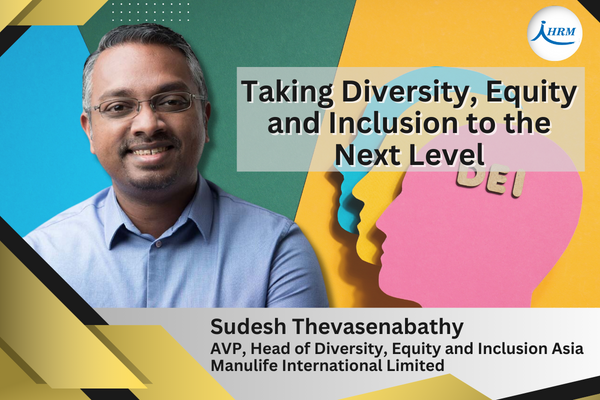
When it comes to implementing DEI initiatives, while global financial services provider Manulife has an overarching DEI strategy, the company believes that tailoring a localised approach to the needs of the jurisdictions and communities it operates in, is more effective than a one-size-fits-all approach. For example, with business activities in 11 markets across the Asia region, instead of rigidly following a formalised DEI strategy that cascades down from Manulife’s global headquarters in Toronto, Canada, Manulife has an Asia specific strategy and within this framework, strategies designed for each Asian jurisdiction. “We focus on what’s important and what really matters in each market,” explains Sudesh Thevasenabathy, AVP, Head of Diversity, Equity and Inclusion Asia, Manulife International Limited. “It’s about making sure the work environment is a psychologically safe place where people feel accepted, valued and included,” he added. This can include the way people are recruited, ensuring underrepresented employees have access to career development opportunities, recognising individual needs and differences, ensuring equitable salaries are offered and providing visibility into the organisation’s DEI policies.
Thevasenabathy points out that a nuanced DEI approach acknowledges and respects different cultures, languages, legislations and norms in each jurisdiction. For instance, in Hong Kong, talent-related disability and LGBTQ+ topics tend to be more widely spoken about than they are in some other parts of Asia. Importantly, Thevasenabathy stresses, Manulife’s approach to DEI avoids labelling or putting people and groups in metaphorical boxes. The overriding aim, he continues, is to ensure that everyone feels they belong and everyone is treated as a human being, while understanding and appreciating that people can be different. “It’s good when we understand that being different is cool,” says Thevasenabathy who frequently speaks at summits and conferences, including making a presentation at the 2023 HKIHRM Annual Conference and Exhibition.
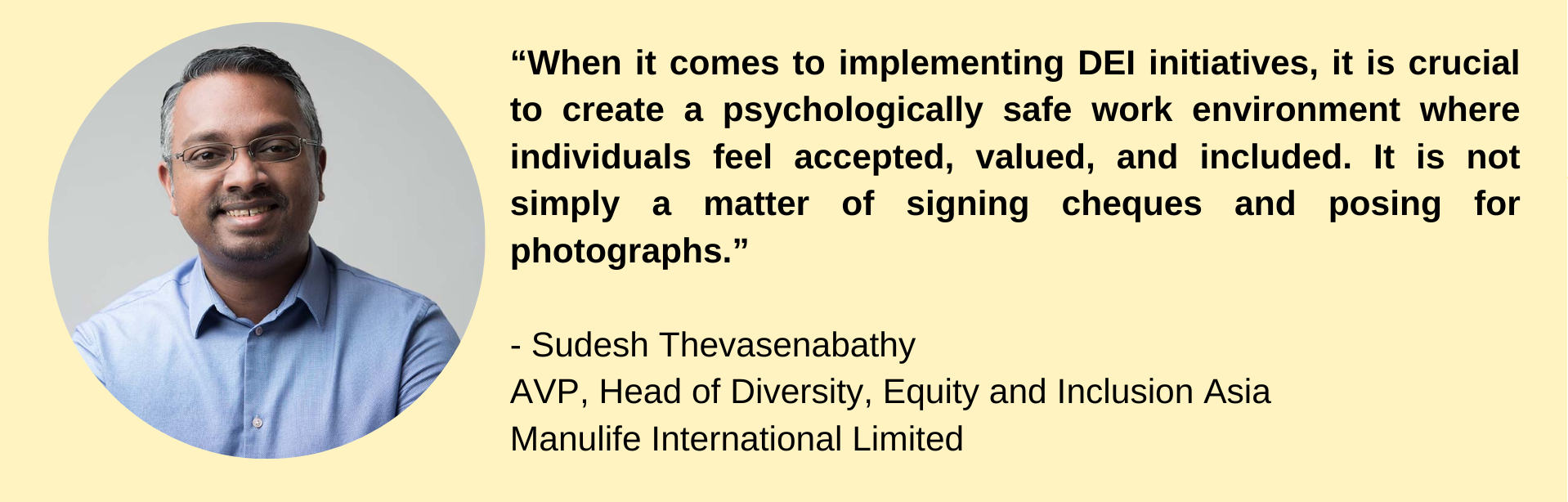
To ensure that DEI strategies stay on the right track, Manulife focuses on four pillars, workforce, workplace, community and business. “We talk to our colleagues, counterparts, regulators and NGOs to get a flavour of what’s important,” Thevasenabathy says. Manulife views this as an effective way of connecting with people, markets and the communities where the company has a presence. A prime example is partnering with NGOs and non-profits to see if talent from those communities can be brought into the business. “It’s not a case of signing cheques and posing for photographs,” Thevasenabathy clarifies.
To evaluate how a proposed DEI initiative could play out in practice, across Manulife’s Asian footprint, test and learn initiatives are deployed in different locations. With the aim of making products and services more DEI inclusive, under the theme of “Diversity in Action”, using human-centred design and design thinking, during a 11-week period a team of 25 Manulife employees drawn from across the Asia region compiled more than 450 concepts and ideas. From the 450 concepts identified, 15 were narrowed down to become milestone ideas. For instance, first trialed in Japan, a sign language service offered through a third-party vendor to enable hearing impaired people to communicate with customer services is being implemented in other parts of Asia. Also, as a result of Diversity in Action brainstorming, Manulife became the first insurance firm to offer life insurance to people in Hong Kong living with HIV. The same HIV life insurance coverage is now being offered to people living with HIV in Indonesia. Instead of working toward one final inclusivity goal or target, Thevasenabathy says listening to employee insights is an effective way to identify areas for attention and prioritise solutions that would best address the organisation’s needs. “It’s one of the advantages of being in Asia and having a cohesive DEI policy,” Thevasenabathy notes. “It allows us to ‘lift and shift’ good ideas and practices.”
Shared responsibility
As organisations realise that effective DEI policies go hand-in-hand with benefits such as greater innovation, a happier and more productive workforce and better talent retention, Thevasenabathy emphasises that DEI is an organsiational responsibility and not exclusively an HR responsibility. “There is no need for the HR function to own the remit,” he says. The onus needs to be on every leader within the organisation to promote a culture that embraces DEI as a business strategy. As such, the HR function should be seen as the “custodians of people and culture”, with the role of supporting and educating leaders to be DEI-centric. “DEI is not just about changing processes, it’s about changing mind-sets,” Thevasenabathy says. To achieve this requires developing strategies to identify and develop leadership development programmes that promote diversity and inclusion. To equip HR practitioners to fulfil this role, Thevasenabathy recommends they follow relevant news about DEI-related concepts, join workshops and webinars that focus on DEI scenarios and share knowledge and insights about culture and values with fellow HR practitioners. Developing a DEI-oriented mind-set can also include a willingness to learn new things about yourself and your colleagues and challenging your assumptions about others.
Changing talent demographics
With estimates predicting that Gen Z will make up 30% of the workforce by 2025, in a competitive market for talent, as the younger generation enters the workforce, an orgainsation’s DEI policies can be a deal breaker, Thevasenabathy says. As the most diverse generation yet, members of the Gen Z cohort typically gravitate toward organisations they view as authentic and in tune with their values, with many willing to forego a high paying salary and other benefits in favour of working for an organisation that is serious about its DEI objectives.
When it comes to measuring the success of DEI strategies, Thevasenabathy says there are a number of ways from measuring how diversity has increased in the organisation over a period of time, to tracking attrition rate across departments, to conducting exit surveys. He adds that a less structured way of measuring DEI strategies, but nonetheless informative, is to read what current and past members of the workforce are posting about the company on social media platforms.
Maintaining the human touch
With growing awareness that bias and unconscious bias — whether by AI or by humans —can be bad news for orgainsations looking to strengthen their talent pipeline, it is important that DEI strategies are embedded in the recruitment and hiring process. As the HR function increasingly utilises AI tools for recruitment and talent management processes, Thevasenabathy notes, since AI models learn from the data they programed with, one of the best ways to mitigate bias is to improve data collection practices to ensure that they as bias-free as possible. While data used to train AI models should be diverse and inclusive to reduce the risk of bias, Thevasenabathy cautions that AI should never be the sole decision-maker when it comes to making final recruitment or talent management decisions.
In addition to operating with a “blind CV” policy, where job candidates’ personal details are masked, Thevasenabathy suggests, before implementing AI into the hiring process, designate a diverse team to audit the decision-making of the AI systems being used. Crucially, any final decisions related to hiring should always be made by a human, Thevasenabathy advises. After all, everything related to DEI is people-centered and nobody wants to be reduced to a number. Simply put, in all things people-related, Thevasenabathy says, remember the “Golden Rule”, treat others the way you would want them to treat you.