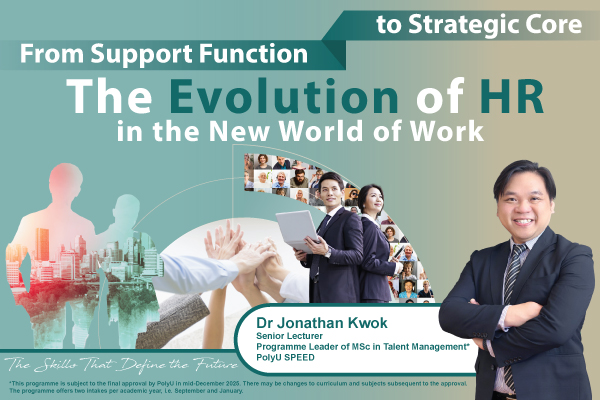
From Support Function to Strategic Core: The Evolution of HR in the New World of Work
Sponsored Article
About PolyU SPEED
- PolyU SPEED offers a diverse range of full-time and part-time undergraduate programmes and master’s degree programmes to equip aspiring individuals with advanced professional knowledge and cross-disciplinary skills. Graduates will receive a degree awarded by PolyU, one of the world’s top 100 universities.
- Its newly launched MSc in Talent Management prepares future HR leaders with strategic insight, data-driven decision-making skills, and the agility to navigate evolving workforce demands. The programme is now open for application for the January 2026 entry.
As the dust settles from the global pandemic, the workplace has undergone a profound transformation. The Great Resignation, the normalisation of hybrid work, and the rapid ascent of artificial intelligence (AI) have collectively redrawn the boundaries of how organisations manage people. For HR professionals, this shift is not merely operational—it is existential.
Gone are the days when HR was viewed primarily as an administrative function focused on recruitment, payroll, and compliance. Today, organisations demand a new breed of HR professionals: strategic thinkers who can align talent with business goals, harness data for decision-making, and lead cultural transformation. In short, the HR Business Partner (HRBP) has emerged as a critical role in navigating the complexities of the modern workforce.
HR at the Decision-Making Table
The HRBP is no longer a support role—it is a strategic one. These professionals are expected to co-create business strategies with senior leadership, design competitive total rewards systems, and build inclusive, purpose-driven cultures. They must also anticipate workforce trends, manage succession pipelines, and use predictive analytics to mitigate talent risks.
This evolution reflects a broader recognition that people are not just a cost to manage, but a source of competitive advantage. HRBPs are now internal consultants, change agents, and business enablers—central to organisational agility and growth.
The Skills That Define the Future
To thrive in this new landscape, HR professionals must develop a robust set of future-ready capabilities. These include:
- Talent Management: Ranked 9 among the Top 10 Core Skills in 2025 in the World Economic Forum’s Future of Jobs Survey 2024, talent management is increasingly recognised as a strategic capability essential for workforce resilience and agility
- Strategic Workforce Planning: Aligning talent strategies with evolving business priorities to ensure organisational readiness
- Data-Driven Decision Making: Using HR analytics to inform hiring, retention, and performance strategies
- Digital Fluency: Leveraging AI and automation to streamline HR operations and enhance employee experience
- Sustainable People Practices: Integrating ESG principles into talent management to support long-term organisational resilience
- Performance and Development: Designing systems that foster continuous learning, agility, and high performance
These competencies are no longer optional—they are essential. As organisations face mounting pressure to adapt quickly, HR must lead the charge in building agile, inclusive, and future-proof workforces.
The Imperative for Strategic Upskilling
Faced with this rapidly evolving ecosystem, ad-hoc training is insufficient. A systematic and comprehensive approach to professional development is now the key differentiator for HR professionals seeking to advance their careers.
Advanced academic programmes—particularly those focused on talent management, digital transformation, and sustainable leadership—are increasingly recognised as vital for building the strategic mindset and technical fluency required. Effective programmes are designed for working professionals, allowing for immediate application of learned concepts to real-world organisational challenges. Curricula grounded in contemporary issues—such as ESG reporting, AI integration, and cross-border workforce mobility—ensure that learning is not theoretical but directly tied to market needs.
Equally important is the opportunity to learn from peers across industries. Exposure to diverse perspectives not only enriches learning but also mirrors the cross-functional collaboration that defines modern HR practice.
Expanding Career Pathways
The demand for strategic HR talent is creating new and diverse career pathways. Professionals equipped with advanced skills in talent analytics, digital HR, and global mobility are finding opportunities not only in corporate HR departments, but also in HR tech firms, consulting, and international workforce strategy roles.
Moreover, the ability to bridge business acumen with people expertise positions HR professionals to take on broader leadership roles, including Chief People Officer, Head of Transformation, or even COO. The intersection of HR and technology also presents opportunities in HR software development, AI-driven workforce solutions, and digital employee experience design.
A Defining Moment for HR in Hong Kong
Hong Kong’s business environment presents unique challenges and opportunities for HR professionals. The city’s high-pressure work culture, talent outflow, and rapid digitalisation require HR leaders who are both resilient and forward-thinking. At the same time, the region’s role as a gateway to the Greater Bay Area and broader Asia-Pacific markets offers a rich landscape for innovation in talent strategy.
HR professionals who embrace this moment—by upskilling, reframing their role, and leading with purpose—will not only future-proof their careers but also help shape the next chapter of organisational success.
Lead the Change: The Strategic HR Era Is Now
The evolution of HR is no longer theoretical—it’s happening now. In an era where talent is the ultimate competitive advantage, the ability to act as a strategic business partner is the most valuable asset an HR professional can offer. By investing in strategic capabilities, embracing digital transformation, and aligning people strategies with business goals, HR leaders can drive meaningful impact and position themselves at the heart of organisational growth.
* This programme is subject to the final approval by PolyU in mid-December 2025. There may be changes to curriculum and subjects subsequent to the approval.