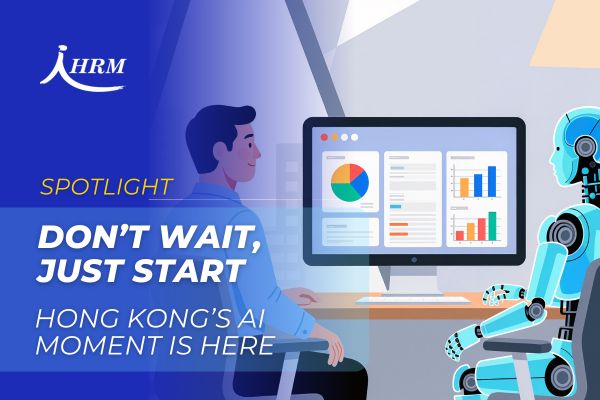
Don’t Wait, Just Start – Hong Kong’s AI Moment Is Here
Key Takeaways
• Organisations should adopt an “AI+” approach, not “+AI”, embedding AI at the heart of operations.
• A people-centric user experience should remain at the core of AI transformation at any workplace.
• Speed is the defining difference between the AI revolution and the internet boom three decades ago, as AI is evolving many times faster.
Introduction
The HR Journal has launched a series of stories on artificial intelligence to explore this emerging trend in the workplace. In this second instalment, a technology industry veteran says the artificial intelligence (AI) revolution is moving far more quickly than the internet boom three decades ago, and that Hong Kong employers must act now to stay competitive.
“Better three hours too soon than a minute too late,” William Shakespeare wrote in his play The Merry Wives of Windsor, a line that many in the AI field treat as a guiding principle when shaping policies. Michael Tam, former Chief Product Officer at Preface.ai and previously the Global Design Principal at IBM, sums it up more directly: “Don’t wait, just start.”
Tam observes that many companies and organisations have fallen into the trap of a “+AI” approach – they look at the most hyped use cases and decide to deploy AI at just certain touchpoints. In HR, for example, this approach might entail using AI for obvious tasks like filtering resumes, but not exploring the other phases along the employee’s journey, such as onboarding, performance reviews, or even offboarding. Firms adopting this patchwork approach are bound to lose out, he believes.
Put AI at the Core: Observe, Reflect and Make
Tam sees the correct approach as “AI+”, a holistic way to embed AI at the heart of the business and deploy it throughout all processes.
Drawing on his time as IBM’s Global Design Principal, Tam recommends the global tech giant’s three-step Enterprise Design Thinking approach — Observe, Reflect and Make
— an iterative paradigm that starts small and scales up progressively, resembling widening spirals that gradually draw in more teams and processes.
Hong Kong companies, organisations, and the city itself are still at the awareness and exploration stage with AI, Tam notes, while some leading regional economies such as Mainland China and Singapore are further down the track and are already implementing policies to fully embrace AI in business and education.
“Hong Kong is in a good place with AI,” he said, “but the field is advancing very rapidly and we need to catch up and move with it.”
Speed: The Defining Difference
Tam draws parallels between the current AI boom and the dotcom era of the 1990s, when the internet triggered waves of innovation and investment. However, he highlights one critical difference: speed.
Built upon mature internet infrastructure, AI is “oven-ready” to grow, scale, and evolve far more rapidly than the internet did in its early days. “AI is smarter than some of the smartest brains and is faster,” Tam explains. “It could bring AI agent-to-agent communication, allowing improved interoperability and even self-learning. We now have reasoning models that can explain themselves — the challenge is handling this rate of change.”
Learning from the Busts
While AI’s boom is undeniable, failures happen faster too. To minimise risks and maximise impact, Tam recommends organisations adopt a people-centric, service-design approach to drive their transformation in this new world.
HR processes illustrate this well: implementing AI should enhance user experience and empower employees rather than simply automate tasks. For example, in promotions and career planning, AI could draw on an individual’s data and provide hyper-personalisation in assessing career growth, evaluating performance, auto-scheduling appraisal meetings, recording minutes, and monitoring progress. AI would greatly improve the process and user experience.
Pilot Squads: Start Small, Scale Fast
Tam recommends that organisations adopt an agile approach by forming small, empowered “Pilot Squads”. These teams should:
- Observe and identify pain points in current operations
- Reflect on AI’s potential to address these challenges
- Make and test rapid prototypes to evaluate results
This iterative approach allows organisations to gather insights, refine their strategies, and scale successful AI initiatives across the business.
Addressing the daunting question, “Where do we start?”, Tam highlights accessible tools like Microsoft Copilot and Grok, developed by Elon Musk’s xAI, which require minimal technical expertise. Platforms like Google Gemini enable organisations to design AI-centric workflows, fostering collaboration between employees and AI systems.
An Enabler, Not a Threat
As AI adoption accelerates, some employees may fear being replaced by AI-powered systems. Tam reassures that AI is not about replacing jobs but enhancing productivity. He quotes Jensen Huang, NVIDIA’s Chief Executive, who said employees should not fear being replaced by AI; the real worry is being replaced by fellow employees who could use AI.
AI is moving at breakneck speed and will transform all aspects of organisations’ operations. To remain competitive, Tam emphasises Hong Kong firms must continue exploring AI and start adopting it — initially on a pilot basis — but then move to broad-scale adoption quickly. They need to adopt a people-centric, AI+ approach and should not wait any longer — the time to start is now.