AI Revolution: A New Chapter in Workplace Innovation
Key Takeaways:
- AI will impact every aspect of business, requiring active involvement of everyone – from senior executives to frontline employees – in redesigning workflows and reshaping operations.
- Mindset of employees, who might think of AI as an entirely technical issue, needs to change; they must realise that AI impacts the entire workplace – no easy task since the field is updating rapidly.
- Workflows need to be redesigned completely; any firm that retains old practices but uses AI tools as add-ons misses much of the benefit.
The HR Journal has launched a series of stories on artificial intelligence to explore this emerging trend in the workplace. Experts in the field will share their insights, guiding HR professionals on how to effectively embrace this transformative revolution.
With the launch of ChatGPT two and a half years ago, the Hong Kong Institute of Human Resource Management conducted its first survey on the use of generative AI in the workplace last year. This year’s survey shows that 73% of companies allow employees to use AI at work. So, should we be paying closer attention to the growing conversation about AI transforming offices?
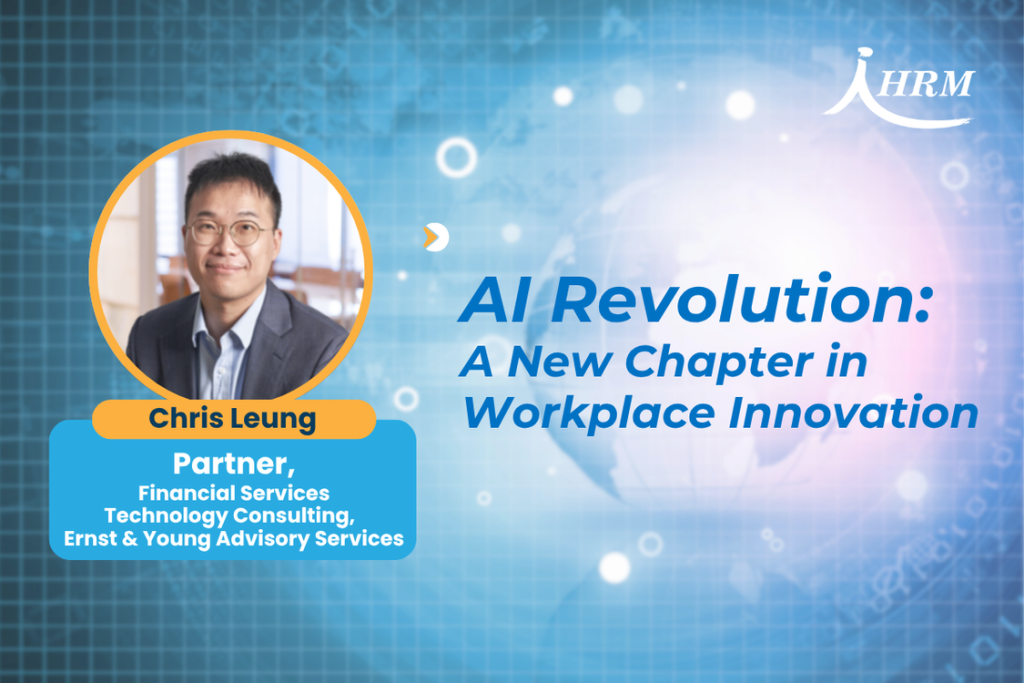
Chris Leung, Consulting Partner at Ernst & Young Advisory Services, predicts profound AI-driven transformations over the next five years. However, the journey toward AI integration presents challenges, particularly in shifting the mindset of employers and employees.
A “Microsoft Office” Moment
A widespread misconception is that AI is purely a technical project, best managed by IT departments. Leung argues that AI integration is, in fact, an organisational transformation that requires the involvement of all departments and levels of management.
“The number one challenge is helping everyone realise that AI transformation requires not only technical expertise but also a holistic approach to deliver business transformation with AI,” Leung said.
Leung draws a compelling parallel between today’s generative AI wave and the introduction of Microsoft Office which drove workplace digitalisation in the 1990s. Just as MS Office unified email, word processing, spreadsheets, and presentations into a single suite that dramatically improved workplace efficiency and enabled the next level of collaboration, generative AI with autonomous decision-making capabilities promises to redefine how work gets done.
Redesigning Workflows from the Ground Up
Traditionally, knowledge systems automated specific decision-making tasks. Today, the implementation of AI calls for a more holistic approach — one that spreads knowledge and skills across the entire organisation.
According to Leung, top management must play an active role in evaluating business operations, identifying areas where autonomous decision-making can add value, and overseeing the transformation. Managers, meanwhile, should focus on redesigning workflows, fostering awareness of ethical AI use, and ensuring seamless and productive collaboration between AI systems and human workers.
“Previously we used just a select team but now we need to spread knowledge and skills across all staff.” Managers need to promote awareness on the ethical use of AI as well as redesign workflows to accommodate digital workers.
He foresees changes similar to those brought by the introduction of Microsoft Office in the 1990s, The comparison of “Microsoft Office” moment extends beyond technology to patterns of adoption.
When Microsoft Office was introduced, younger employees who had used the software in school adapted quickly, while established employees were slower to grasp the changes.
Leung expects a similar dynamic with generative AI. Uptake may initially be uneven, but ultimately, AI tools will become embedded in everyday workflows — enhancing, not replacing, human workers.
Diverse Offerings
Unlike the MS Office revolution, today’s AI landscape is far more fragmented. Organisations can choose from a wide array of tools from vendors like Google Gemini, Amazon Web Services, Alibaba Cloud, DeepSeek, as well as different open-source large language models (LLMs). This diversity offers flexibility — but also complexity.
“AI field changes very quickly,” Leung said. “Last year the discussions were all about GPT and LLMs, now it is all about AI agents.”
According to Leung, merely tacking AI tools onto legacy workflows is a missed opportunity. “The return on investment (ROI) of AI transformation programmes comes with enablement of new business capabilities. If the business process remains the same, just using AI solutions as add-ons, then the business is not realising the full potential of AI,” he warns.
Key concepts that system architects need to understand when redesigning workflow for AI include that of the AI agent or digital worker – a set of applications with a specific persona which mimics many of the actions of a physical staff member.
Another key concept is that of the Target Operating Model (TOM), which defines the desired future state of an organisation and serves as a blueprint to align executive and management transformation efforts. The TOM outlines the people, processes and technologies required to enable seamless collaboration between human and digital workers to cooperate, and establishes how to orchestrate workflows with staff and AI agents for different business scenarios.
This leads to the prompt playbook, setting out practices for each digital persona to leverage AI and LLM in order to carry out their tasks.
Addressing Transparency and Risk
As AI systems become more prevalent, transparency and risk management take centre stage. Organisations need to assess their available data and may need to supplement it with third-party datasets.
Unlike traditional software purchases, AI tools are often accessed through multiple providers’ cloud platforms, adding complexity to implementation.
Another key issue with AI is transparency. Leung likens AI disclosures to food nutrition labels, advocating for full transparency about the data and processes behind AI systems. Just as consumers rely on nutrition labels to make informed choices and build trust in what they consume, stakeholders need similar transparency to understand and trust how AI systems operate. In this way, trust in AI is built through transparency – when the ingredients and mechanisms are visible, confidence follows.
AI systems also bring varied risk levels. For example, biometric data demands stringent security measures, whereas chatbots carry relatively lower risks. Organisations must tailor security and transparency measures to the specific AI application.
Navigating a Rapidly Evolving AI Landscape
The emergence of generative AI and its enhanced computing power has placed AI integration at the top of organisational agendas. Generative AI enables the creation of digital personas capable of autonomously performing detailed tasks, impacting employees across all levels.
Leung highlights the evolving demand for interpersonal skills, now extending to include effective interaction with AI systems. “Interpersonal skills have always been important,” Leung said. “But now we must also focus on skills for interacting with machines.”
AI has undeniably reached a pivotal moment, one that demands not only technical expertise but also a fundamental transformation of business processes, organisational mindsets and workplace interactions. Those who embrace this shift will unlock AI’s immense potential — redefining productivity and innovation for decades to come.
Explore More