As the unrelenting impact of COVID-19 continues to sweep organisations large and small, Hong Kong employers are taking a wait and see approach to 2021 employee salary increases.
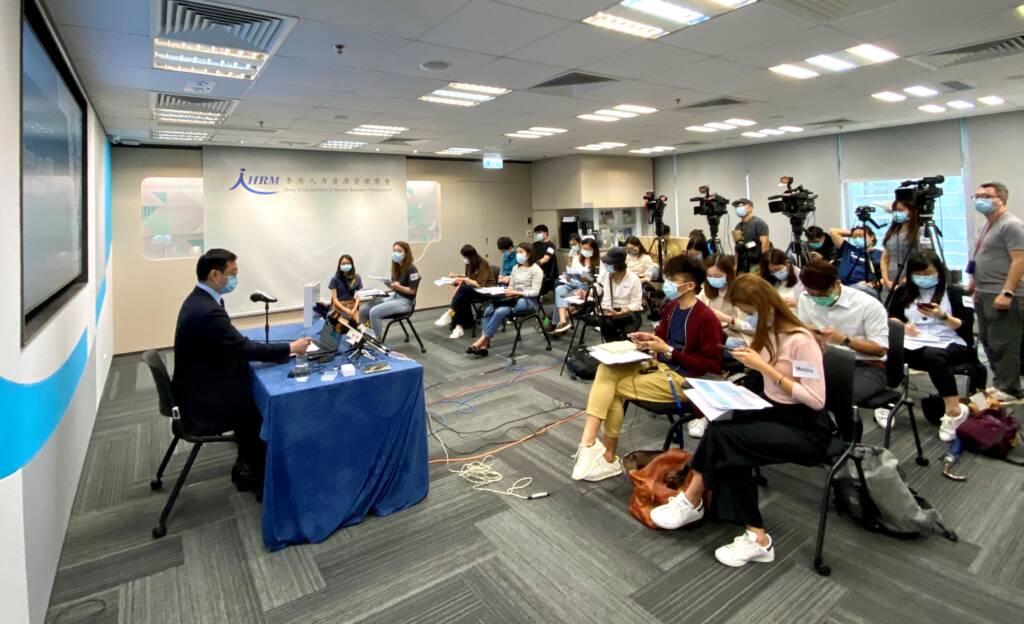
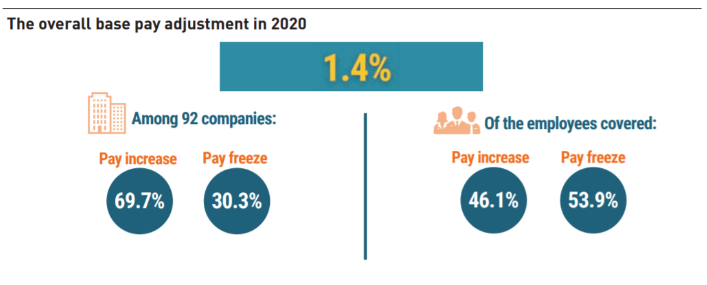
Conducted between January and September in 2020, the Hong Kong Institute of Human Resource Management (HKIHRM) 2020 Pay Trend Survey fi ndings were based on data provided by 92 companies from 15 different business sectors, involving about 127,800 full-time salaried employees. Widely anticipated by Hong Kong’s HR community, the survey records the trends for pay adjustment, bonus incentives and benefi ts provided to employees. In 2020, according to the survey fi ndings, Hong Kong employees received an average salary increment of 1.4%. Adjusting for infl ation, which averaged 0.9% from January to August 2020, the real base pay adjustment amounted to a modest 0.5%.
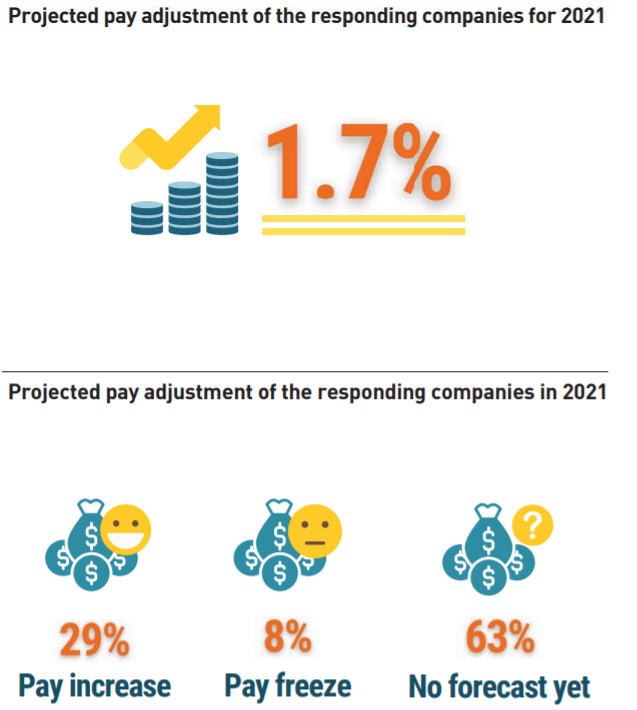
Based on the HKIHRM 2020 Pay Trend Survey fi ndings, of the 89 responding companies which answered the question about 2021 salary increases, 62.9% reported they had yet to conduct a pay adjustment projection for 2021. While employees can still expect salary increases in 2021, increments are likely to be minimal. Among those companies that provided data on base pay adjustment projection for January to April 2021, the projected pay adjustment is 1.7%. Only 7.9% among the companies that responded stated that a pay freeze is likely to be put into effect.
In 2020, small-sized companies employing fewer than 500 staff offered the biggest pay rise at 1.8%. This was closely trailed by 1.5% for mediumsized companies employing between 500 and 1,000 staff, and 1.4% for large companies employing more than 1,000 staff. Among the responding companies, 69.7% provided a pay increase, 30.3% documented a pay freeze, and none implemented a pay cut. The proportion of employees who received a pay rise was 46.1% while 53.9% experienced a pay freeze.
For pay adjustment according to employee level, senior level staff received the highest pay adjustment at 2.0% while general level employees lagged behind at 1.4%. Same as 2019, company performance and individual performance nabbed the two top spots respectively as the main pay adjustment factors for 2020. However, unlike 2019, refl ecting the city’s fi nancial downturn, Hong Kong’s economic conditions rose two ranks to become the third most impactful salary adjustment factor.
Guaranteed and non-guaranteed bonus
Among the companies which provided data on bonus payments in 2020, 44.6% reported that they had a guaranteed bonus scheme in place during the survey period. The average size of guaranteed bonus remained at 1.01 months of base pay; a fi gure that has remained unchanged since 2017. Meanwhile, 94.6% of the companies that provided data reported that they had a non-guaranteed bonus scheme in place during the survey period. Among all the surveyed employees, 82.7% were eligible for a non-guaranteed bonus plan. For eligible employees who were awarded this incentive, the average size of a non-guaranteed bonus was 1.77 months of base pay. In terms of the size of non-guaranteed bonus amounts by employee level, top level staff were rewarded with 6.04 months of base pay. Senior level, middle level and general staff received 2.67, 2.07, and 1.40 months of base pay respectively.
Compensating employees with family-friendly policies
Commenting on the survey fi ndings, Lawrence Hung, Vice President of the HKIHRM, said the reticent approach to salary increases refl ects employers’ current sentiments. “Economic uncertainty caused by COVID-19 continues to be a major concern for organisations, which is affecting employers’ pay adjustment forecast,” Hung said. While organisations are facing sustained pressure to keep costs down, there are other ways to recognise and compensate employees.
“Salaries are just one component of a total compensation package,” Hung said. For instance, spearheaded by the HR function, employers can demonstrate they care about their employees by redesigning and expanding family-friendly policies. While these are important for all employee levels, they can be particularly signifi cant for lowincome employees who tend to be more vulnerable during economic downturns. Where feasible, he suggested, low-income employees whose onsite presence is necessary can start and fi nish work during offpeak hours, which helps reduce concerns about social distancing. Furthermore, employers can provide them with subsidies for mobile data and Wi-Fi as business expenses, to foster good will through this modest gesture.
Employers can also consider being fl exible with the way accrued annual leave is taken. “With travel restrictions in place, employees have fewer options in the way they can spend their annual leave,” Hung elaborated. Employees can take leave on an hourly basis, allowing working parents to take care of their kids who are studying at home. In addition to providing employees with appropriate protective equipment, with the pandemic heightening awareness about health and wellbeing, employers could work with their medical insurers to expand employee medical coverage. “This can provide a lot of reassurance,” he noted.
Empathy is key to supporting employee wellbeing
With consecutive waves of COVID-19 responsible for infl uencing remote work policies and causing uncertainty, Hung believes the need for clear and concise communication has never been more signifi cant. He also believes when communicating with employees, it is equally imperative to lead with empathy.
Empathy involves letting employees know they are being supported and cared for, and that they should feel comfortable discussing work and nonwork-related challenges. For example, the ability for employees to work from home should not be taken for granted by employers. “Space, especially in Hong Kong, is often a luxury, and many employees will be competing for space and internet bandwidth with family members while trying to focus on their work commitments,” Hung said.
With work practices a long way from being “business as usual”, it is imperative to communicate with employees frequently to keep them up to date with relevant information. At the same time, with line managers and team leaders most likely to have the most frequent contact with employees, HR can support them with communication and empathy skills training, to help them keep their team members motivated, engaged and connected.
Pointing out that there is no standard communications guidebook, Hung advised that whatever the communication channels used, it matters to give employees an opportunity to ask questions and voice their concerns. “Often the best ideas and solutions come through feedback from employees,” he said, citing examples of employees using their organisation’s communication platforms to share work and non-work-related experiences and strategies. Ultimately, Hung said, it is about letting employees know that overcoming challenges is a collective effort, and the organisation has got their back.
Bespoke wellness programmes and work from home tools
Given the uncertain economic outlook, Senna Cheung, CoChairperson, Remuneration Committee, HKIHRM, said business performance would be the main factor that determines the budget for pay increases. “Salaries account for a large portion of an organisation’s overall budget, so employers can be expected to be prudent with any salary increases they offer,” she said. When a salary increase is offered, it will most likely be to selected high performers.
However, with more employees working from home in lieu of offi ces, evaluating top performers could require a new matrix for measuring performance. Citing leadership roles as an example, Cheung said charismatic skills that work well in a physical workplace now need to be blended with project management and strong communication skills to successfully lead a workforce operating remotely.
While employers can be expected to take a judicious approach to any salary budget increase, Cheung believes there are family-friendly ways that employers can demonstrate to employees that they are valued. A good example is to ensure employees have the appropriate equipment and technological tools to make working from home as effective as possible. This could include providing ergonomic chairs and supporting employees with physical and mental wellness programmes.
Cheung pointed out there are online wellbeing programmes, including free ones HR practitioners can tap into to improve their subject matter knowledge. HR professionals can help develop bespoke programmes for employees, many of whom are juggling the needs of children, partners, parents, and other responsibilities. “Employers need to show empathy and ensure employees that they have a family-friendly approach to work from home expectations,” she explained.
Led by the HR function, employers could schedule optional virtual events that get employees interacting outside their normal work roles, creating a sense of teamwork and camaraderie. “We need to have some fun and laughs, even if we are working in a remote work environment,” said Cheung.
HR-related insights from topic experts
Entitled “Redesigning C&B Strategies in the New Normal”, the Pay Trend and Benefi ts Seminar 2020 was held as a webcast due to the need for social distancing. Various prominent speakers across the sectors provided their perspectives relevant to the HR profession. The webcast was kickstarted by Alice Wong, Vice President, HKIHRM. She gave an opening speech about HR professionals’ vital role as business partner and mentor, who can break new grounds alongside the management team by adopting a creative approach towards salary and benefi ts, fl exible arrangements such as working from home and AB teams.
Referencing the new normal induced by COVID-19, Nicholas Kwan, Director of Research, Hong Kong Trade Development Council, presented his economic outlook for Hong Kong for 2021, which he termed “a year of no signifi cance”. Senna Cheung shared the 2020 Pay Trend Survey Highlights with participants.
In keeping with the new normal theme, Brian Sy, Principal, Head of Career Products and Total Rewards, Mercer (Hong Kong) Limited, offered his views on reinventing rewards management of regional areas. Kris Lui, Council Member and Chairperson of Research Committee, HKIHRM, provided the highlights of the 2020 Topical Study: HR Challenges in the New Normal.
Elaine Ng, Director/Founder, Management Resources Consultants (Asia) Limited, took a studied look at using AI in predicting salaries and whether it is trustworthy. Portia Tang, Director and Head of Professional Resources Solutions and Client Services, BDO, delivered her insights on how businesses can make their best comeback from the resourcing perspective post-COVID-19. Additional highlights of the webcast included presentations by Dr Sonny Hon, Private Practice Neurologist; Constance Yuen, Chief of Staff, Cigna Worldwide Life Insurance Company Limited; and Crista Kwok, Director, BodyGo Training and Counselling Centre.