HR Competency Study
What are the key insights of HR Competency Study Round 8 and how do they shape HR’s future?
The University of Michigan and the RBL Group have done seven rounds of the HR Competency Study and have just completed the eighth round with 19 global partners and survey data from over 29,000 respondents. At a high level, we discovered:
HR is not about HR, but the delivering of results for all stakeholders (employee wellbeing, business strategy, customer commitment, fi nancial performance, and community reputation).
HR contributes to these results through insights on human capability (talent, leadership, organisation).
HR departments can be transformed to deliver results; HR professionals can increase business capabilities and master fi ve competencies to deliver results. Transforming HR departments and increasing business capabilities matter more to business results than HR competencies.
Learning and applying these results help deliver HR’s impact in a changing world.
COVID-19’s impact on the world of work
You often speak about the evolving role of the HR function in a changing world. How has COVID-19 transformed HR? Is there a greater emphasis on personalisation in different facets: emotion, empathy, engagement, experience and efficacy?
When we think about what’s next after COVID-19, we recognise that personalisation may be part of the new normal. Firstly, we can contemplate each person’s personalisation in the facets of emotion, empathy, engagement, experience, and effi cacy. These words tend to show up with increasing attention on affi nity in relationships and organisations. Organisations can, or should, become communities where employees fi nd resources that provide personal emotional support. Secondly, personalisation also refers to creating more personalised work responses through customised actions at both the employee and organisation levels. Individuals differ in their demographics (e.g., race, gender, age, education, and lifestyle), professional ambitions (ranging from low to high aspirations) and personal goals (defi nitions of success). Leaders and organisations tailor actions for each individual, depending on his/her unique situation.
From the HR perspective, how has COVID-19 altered people’s understanding of organisations and how can the HR function play a major role by developing new skills and reskilling in ensuring corporate sustainability?
Once invited to business conversations, the HR function participates by offering unique contributions in the human capability areas of talent, organisation, and leadership. These three areas of contribution are not new, but they are even more critical than before in companies’ response to current challenges and discovery of future opportunities.
HR offers unique insights around individual competence (workforce, skills, talent or people). The legacy of the HR function has been to fight the war for talent and focus on ensuring that employees have the competencies (right job, right place, and right time), high commitment (employee value proposition) and contribution (a positive employee experience). It now links employee experience to customer experience and investor confidence.
HR also offers unique insights about organisation capabilities (workplace, culture or process). Wars are fought with people, but victory comes from how well the organisation turns individual ingredients into organisational identities. Our research at the RBL Group and University of Michigan found that the capabilities of an organisation have four times the impact on business results than the competence of individuals.
Talent and organisation are shaped and driven by leaders. Employees (individual competencies) often mimic what their leaders do, and organisation capabilities often reflect leaders’ personalities. More importantly, leadership at all levels of the organisation signals thoughts and actions that get attention.
In any business conversation, HR brings insights, tools, and actions on talent, organisation, and leadership to deliver stakeholder value.
COVID-19 has essentially fast-tracked digital transformation. What are the major themes, trends, and challenges relating to digital transformation the HR function can use, to benefit its own operations as well as employees and the organisation?
Digital HR means that HR uses digital technology in four phases, which reflect the evolution of digital HR, with phase 4 (connection) as the emerging agenda.
Phase 1: Efficiency: To what extent do we use technology to streamline administrative HR work?
Phase 2: Innovation: To what extent do we use technology to innovate our HR practices?
Phase 3: Information: To what extent do we use technology to access information?
Phase 4: Connection: To what extent do we use technology to create connections and a positive employee experience?
Even as digital HR enables efficiency (phase 1), innovation (phase 2) and information (phase 3), its emerging impact will enhance connection (phase 4). Being connected overcomes loneliness (social isolation) and underlies employee experience. The need for connection is high as recent research has found that social isolation increases mortality rates more than smoking, obesity, or substance abuse.
What are the major trends in HR’s shaping of a talent agenda? Amid COVID-19 the HR function has been challenged to build a talent management strategy to attract, recruit and retain diverse professionals. As the focus shifts to post-COVID times/ the next normal, what does the HR function need to do to provide talents with a promising future of work?
Talent (workforce, individual competence, skills, expertise/ knowhow, etc.) has been the hallmark of HR for decades. In our talent research and work, we have identified three major talent domains (competence, commitment, and contribution or experience). Within these three domains, we have identified 10 talent initiatives and have worked to show which of these impact employee, strategy, customer, financial, and community results. We have found that –
In general, the talent activities with the most overall impact on results are acquiring the right people and tracking their employee engagement. The talent activity with the least overall impact on results is removing people.
Employee results increase the most through tracking employee sentiment and managing performance.
Business strategy results are most accomplished through acquiring the right people and tracking their engagement.
Customer results are most impacted by tracking employee engagement, communicating with employees, retaining the best employees, and acquiring the right employees.
Financial results are most impacted by developing employees, acquiring employees, and managing careers and succession.
What are the most important leadership skills needed in the new world of work? How can the HR function help to identify, train, develop and nurture the required suite of skills?
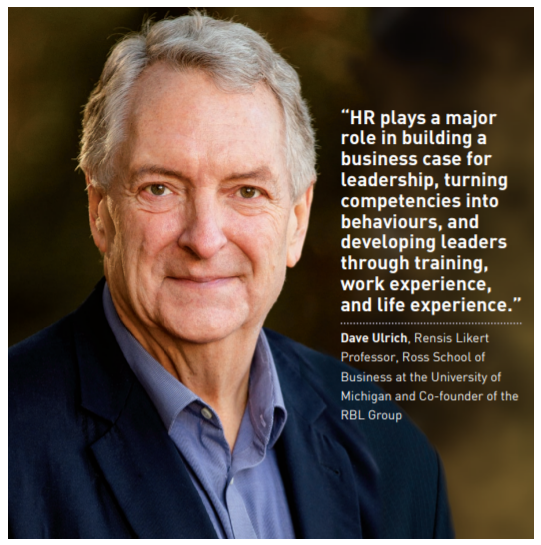
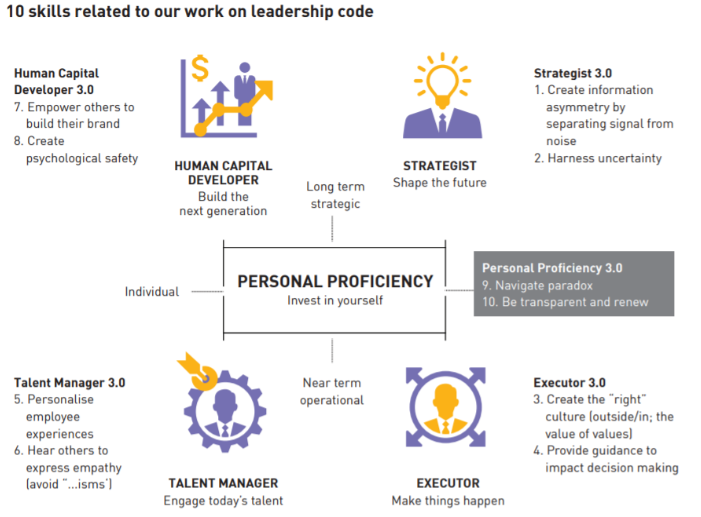
We have studied what leaders should know and do in today’s world and have identified 10 skills related to our work on Leadership Code. To use these 10 skills to deliver results, HR plays a major role in building a business case for leadership, turning these competencies into behaviours, and developing leaders through training, work experience, and life experience.
Employee experience
Employee experience has become a critical element of the work experience as staff believe that finding meaning and personal fulfilment is crucial to employee overall wellbeing and productivity at work. What does the HR function need to be proactive in making sure employee experience receives the necessary attention?
Tracking employee sentiment about work is not new and has gone through an evolution of ideas around motivation, satisfaction, commitment, and engagement. The employee experience (today’s ideas) focuses on helping employees believe (meaning, purpose), become (learn, grow), and belong (relationships, community). When employees discover believe, become, and belong in their work setting or in specific HR practices, their experience goes up. This employee experience then affects customer experience and financial performance.
Which skills will be the most challenging to teach at scale to help employees adapt to working from home?
A number of groups have identified soft skills required for the future workforce (e.g. World Economic Forum’s The Future of Jobs Report). In recent work on leadership effectiveness, we have found that leaders have to navigate paradox, which means managing tensions and differences. The ability to steer through paradox enables leaders to adapt and change both themselves and their organisations. We see four skill sets (goal setting, relationships, information, and adaptability) that leaders at all levels and in all industries need to navigate with specific skills. When leaders master these four skills sets and can steer through the paradoxes associated with each, they deliver employee, organisation, customer, and investor results.