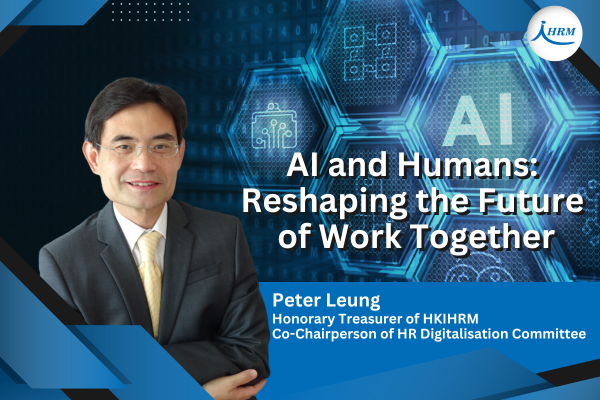
AI and Humans: Reshaping the Future of Work Together – By Peter Leung
Key Takeaways:
- AI technologies are not only changing the nature of work for employees, AI technologies can also enhance the employee experience.
- As AI continues to evolve, it is increasingly important for organisations to adapt and prepare their workforce through upskilling and reskilling for the changes it brings.
- With the goal not to replace humans, but instead augment human and AI capabilities, the HR function needs to focus on designing jobs that incorporate flexibility and adaptability.
- Investing in workforce reskilling includes helping employees to develop skills at a higher cognitive, analytical and conceptual level.
- As the use of AI continues to scale up within businesses and across industries, organisations need to promote life-long learning to develop a future-ready workforce.
The rapid and widespread adoption of tools such as Open AI’s ChatGPT, Google Bard and Microsoft’s Bing have certainly led to one thing: Everyone is talking about how Generative AI (GAI) is changing the way we work.
Peter Leung, Honorary Treasurer and Co-chairperson of HR Digitalisation, Hong Kong Institute of Human Resource Management (HKIHRM) believes while Generative AI and associated artificial intelligence (AI) tools have the potential to provide solutions to many business challenges, the implementation and processes for using AI needs to be thought through and carefully managed to make it effective and productive for corporations.
The stakes are high, Leung says. For the HR function navigating the AI workforce transition, the key to strengthening employee recruitment, engagement and retention, unlocking the productivity potential of AI while delivering on business objectives lies in three key strategies: (1) Re-balancing corporate resources, (2) Investing in workforce reskilling , including on an ongoing basis, (3) Commitment to advancing new models of career development, which could be achieved through lifelong learning.
Speaking from the perspective as a human resources professional, Leung says he is impressed by how AI tools are replacing repetitive HR tasks such as screening resumes, short listing candidates, checking personal data and scheduling interviews. According to the institute’s research based on the World Economic Forum report, by 2025 automation and workplace digitisation will disrupt 85 million jobs globally. Meanwhile, another forecast by the World Economic Forum predicts that close to 100 million new automation and workplace digitisation roles will be created across an extensive range of industries.
As organisations move towards more extensive use of GAI and other AI and automation tools, Leung predicts an upsweep in the demand for data science professionals with the ability to extract insights from large and complex data sets, experts with knowledge of security frameworks, risk management and data privacy regulations. There will also be an increase in demand for talent with the ability to design and develop software applications and systems. Corporations will be hunting for talent with the ability to create and implement digital marketing strategies, develop search engine optimisation tools and social media marketing and customer analytics. The focus, Leung says, will be on jobs that ensure that operating systems are safe, ethical and provide transformative benefit for our society. “To adapt to an AI-influenced future, especially for young people, it is important to develop skills at a higher cognitive, analytical and conceptual level,” Leung says. Encouraging and creating a culture of continuous learning is imperative to ensure that AI is not perceived as a threat to employees, but a way to assist and enhance their work. To this end, when developing career paths, Leung recommends that certification on analytic skills and qualification on data science are viewed as integral career development objectives by both organisations and individuals.
Perceptions of AI in the workplace
Human-AI interaction reveals that individuals’ perceptions of AI are based on different aspects. While AI can bring many benefits, Leung points out it can also raise important questions about the way AI tools are used and the potential impact they can have on employees as well as the organisation. Citing an elaborative HKIHRM survey, Leung says the three main areas of concerns raised by respondents are cybersecurity risks associated with the use of GAI tools, a lack of knowledge and relevant expertise to implement GAI tools and copyright issues.
Commenting on the topic of data accuracy in relation to GAI tools, if there was to be a breach of data accuracy from an article generated through AI, Leung says it may be debatable on the proportion of responsibility between the AI tool and the writer. Nevertheless, Leung stresses the importance of human effort to monitor and oversee AI learning processes to ensure the “big data” generated is not skewed towards bias, which may result in error or discrimination issues. To address these potential issues, Leung recommends that organisations create policies for executives to systematically govern AI decision-making processes and establish mechanism to monitor, investigate and address any instances of potential AI errors or oversights.
Introducing AI as an ally
With AI set to continue to revolutionise the world, Leung believes it is important for organisations to implement AI in an ethical and responsible manner. “It’s about finding the right balance that brings humans and machines together to ride on the rising tide of AI,” notes Leung. For instance, Leung highlights the importance of the HR function working closely with all areas of the organisation to re-structure jobs in a way that makes the best use of talent and technology working together. “The HR function needs to focus on designing jobs that incorporate flexibility and adaptability,” he adds. The goal is not to replace humans, but instead to implement AI tools that can be used to augment human capabilities, with the focus on making work more effective and, in the process, make employees’ and everybody’s lives better. The key, according to Leung, is to invest in the type of training and development that enables employees to work in collaboration with AI systems. “It is important for employees to understand how and why AI tools are being used,” he says. As such, the HR function has a leading role to play in preparing the workforce for the inevitable disruption which technology can create. This means cultivating a culture of innovation where the workforce is open to new ideas and new ways of doing things. Do not be afraid of letting go of the usual ways of doing things. Equally important, Leung stresses, is avoiding the risk of becoming swept up in the possibilities that new technology can offer at the expense of forgetting the unique capabilities that human talent can offer.
While advancements in technology mean that AI systems can be coached on some parameters of creativity, creative thinking remains a predominately a human strength, says Leung. “AI tools have their limitations,” he notes. As the use of AI becomes more prevalent, Leung believes that so too will the need for what humans can do best –creativity and conceptual problem-solving. For example, while AI can collect data and spot patterns, it lacks the capabilities to match the human capability to apply cognitive and conceptual analytics to data and come up with fresh ideas. Another important area where human talent holds the upper hand over technology, Leung points out, is the emotive and perceptive interactions people have with each other. A prime example is performance management. “If an employee is experiencing a performance issue they need to speak to his/her boss or peer, not a machine,” Leung notes. The need for human-to-human interaction also applies if an employee needs counselling or has a complaint that needs to be handled. “I think there it will still be some time before we see Generative AI overtake the human ability for interpersonal communication or the ability to network and collaborate,” says Leung.