AI: Another Tool in the HR Toolkit
Key Takeaways:
While AI technology is evolving rapidly, the hype can be misleading, therefore be excited, be curious, be cautiously optimistic, but also be careful.
As more AI tools are made available, it is important that HR practitioners sharpen their critical thinking and evaluation skills instead of automatically accepting AI-produced solutions.
To ensure AI tools are integrated effectively, HR practitioners need to make sure that human decision-making is the ultimate decision-making.
With the escalation of AI is set to continue, to avoid bias, AI systems need to be trained by data sets that are inclusive.
As the era of human and machine develops, what differentiates the HR practitioner of tomorrow is the ability to empathise, mentor and initiate meaningful human-to-human interactions.
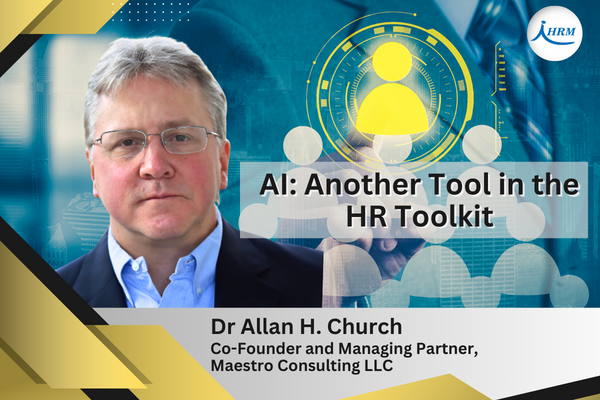
With rarely a day that goes by without artificial intelligence (AI) being trumpeted as a either a game-changer or an existential risk, Allan H. Church, PhD, Co-Founder and Managing Partner, Maestro Consulting LLC provides insights on the various ways that HR practitioners can make use of AI while balancing AI’s capabilities with human strengths such as empathy, creativity and critical thinking.
The fact that Artificial Intelligence (AI) is already changing the world of work is well established. Whether through processing large amounts of information or data on people, such as in recruiting by screening resumes or scraping the internet and social media, or bringing together disparate content and resources such as creating individual development plans or matching internal job opportunities to skills and interests, the utilisation of AI is set to continue. The rise of the “talent marketplace” concept that many companies are exploring or have already put in place is a prime example of where AI would appear to solve some of the most challenging aspects of employee growth and development – i.e., finding that next great job, role, or experience internally. Other less visible but equally important applications of AI include areas such as workforce planning support, embedding analytics in employee surveys and feedback tools, assisting with performance management, or improving the quality of feedback provided through prompts, nudges and other approaches.
AI also plays an important role in the backend applications of the HR function with respect to improving data quality and integrity across systems. However, instead of reflecting on the hype, but on the reality of what AI is and does, it’s not really an entirely new concept for the HR function. Earlier precursors and incarnations of AI in the form of data programming and inferential statistics have been used by HR practitioners for decades. The difference today is that techniques are being applied in more advanced ways involving larger and more complex forms of data. For example, some of the benefits that AI applications can offer include sifting through reams of data and generating outcomes for HR and talent management related decisions (e.g., internal and external candidates for placement and selection, action plans, development interventions, modeling relationships across different data sources to spot trends). When done well, these outcomes can save the HR function time, money, and resources that can be applied to more meaningful work such as coaching and mentoring employees, development leadership or talent frameworks and designing new roles. Of course, some might argue that AI can do all of these functions, and one day it well might, but we are not there yet.
On the other hand, the challenges and concerns, particularly when AI is misused and/or misunderstood, are very real. Although there are many examples to point to, the concerns that HR practitioners should be particularly aware of include: building in systemic biases into algorithms that impact employee decision-making, evaluating information without the lens of ethics or human integrity, which could impact employee privacy, well-being, and engagement not to mention productivity, and providing outputs and recommendations that appear to be equally credible even when the information being used may not be. In short, AI in its current incarnation lacks judgment and ethics. And this is assuming the data that AI applications and tools are using is clean and complete, which often they are not. Add to this the fact that many people simply take outcomes delivered by AI applications for granted versus truly delving into the “black box” that delivers the output. With this in mind, if people spent more time trying to understand how the different algorithms actually work (e.g., what is included, weighted and corrected), they may be in a better position to appreciate the benefits and challenges that AI tools provide.
This is why it is important the end users —including HR practitioners — of information provided by AI applications, fully understand the sources of inputs and the nature of the underlying algorithms. The reality is that technology will keep evolving and advancing, potentially for the greater good. Nevertheless, it is incumbent on HR practitioners to truly understand what AI tools can do or cannot do, especially when working with the output it produces. Most HR systems in large major corporations have all sorts of challenges, so relying solely on the recommendations from AI can be hazardous. Furthermore, in the future, with the possibility that “dueling AI” applications will be used to navigate HR activities; it is crucial for HR practitioners to sharpen their critical thinking and evaluation skills instead of automatically accepting an AI answer.
AI challenges with implications for the HR function
There are two forms or applications of AI that point to these challenges with implications for the HR function. The first is with machine learning (ML). If we fully buy-in to the concept of ML, we would believe that the algorithms being used for employee screening and job matching platforms are getting more accurate over time. And in a sense they are. But as many examples, some with significant legal ramifications for major corporations have shown, “more accurate” might not be better from a diversity, equity and inclusion point of view, particularly when algorithms start to replicate inherent biases in an organisation’s staffing, succession or performance management process. While the ML application may be “learning” what it is really doing is making its underlying multiple regression models more and more predictive of the outcome based on the data it is collecting.
Generative AI
Another area of the AI suite of tools that is rapidly emerging is the use of generative AI. For many, this feels like a true revolution, and while the technology is certainly impressive (and quite wide ranging across multiple media), in essence generative AI operates by pulling information from a huge database and processing it in a form that end-users feel like it’s real to them. Simply put, generative AI structures language in a way it can be automated. As with all AI, the same rule of garbage in and garbage out applies. From an HR perspective, if you are interested in content that is widely available and want it pulled together (e.g., writing a termination letter, job evaluation, performance review, employee profile, data report syntheses) there are millions of data points available for ChatGPT to generate a majority of solutions. On the other hand, try searching for information on topics or content that is new, innovative, proprietary, or otherwise not deeply embedded, and the results may be less valid – even if the results appear to be convincing. It is always important to know the source of the data being used. For HR practitioners it is vital to understand where the generative AI information is coming from and approach the output as something to be evaluated and considered rather than the objective truth. For example, just because ChatGPT can produce an employee severance document it doesn’t mean that HR practitioners should consider issuing it without first reviewing it with their legal department.
Understanding the process
Given the rate at which AI is evolving, including the legal and regulatory landscape along with it, the best approach for HR to learn about AI is to focus on three different sources of information. First, pay attention and keep current on the popular business and HR trade journals and news outlets. It’s important to stay up to date on what people are saying, legal cases being brought forward, new applications and case examples.
Second, do a deeper dive into the real theory and research emerging in the fields of I-O Psychology (where selection, performance and assessment are key areas of practice and study) and Organisational Behavior. On this front many academics and practitioners are joining forces to better understand, guide and address the benefits and challenges of AI in organisational life.
Third, select one or more AI related applications that your organisation is using or thinking of using and spend time truly understanding the algorithms behind the “black box” of the system. How does it work? What data does it use? What assumptions are being made and what rules and relationships are behind the algorithm? Without access to the black box, be very wary of that AI application. There is increasing legal and regulatory pressure to be transparent and for good reason.
Be excited, be curious, be cautiously optimistic, but also be careful. While AI technology is evolving rapidly, the hype can be misleading (both positive and negative). Begin building capabilities in the HR function to take advantage of what AI can offer – be it data skills, programming skills or soft skills. Also, spend the time to better understand what types of AI tools and applications there are already in place in the organisation. There could be some that you might not even have known about. Whenever possible, experiment and pilot some of the new AI applications, however, maintain a watchful eye toward quality inputs and outputs and give thought to where you see the company going in the future. In summary, AI is real and will continue to have a significant impact on the nature of work and the HR function in the future. As with the development of all technologies, it may not happen as predicted or planned. Consequently, perhaps the best way for HR practitioners to think about AI, is simply as another tool in the HR toolkit.