In the ever-changing world-of-work environment, the Hong Kong Institute of Human Resource Management (HKIHRM), “2023 Future Workforce Study” findings are valuable to HR professionals and organisational leaders as useful reference points for shaping recruitment, training and talent development strategies.
Commissioned by the HKIHRM, sponsored by Jobsdb by SEEK and conducted by the Hang Seng University of Hong Kong, from June to August 2023, data was collected from over 900 respondents, including the HKIHRM membership database, Jobsdb database, business partners, industry associations and higher education institutions. The study aimed to identify gaps in employer/employee expectations regarding reskilling and upskilling, examine the significance of life-long learning in relation to maintaining competitiveness in the era of technology, and generate valuable insights to inform HKSAR government policy formulation.
In a competitive talent-hiring landscape, to meet recruitment and retention goals, survey findings revealed that when it comes to fulfilling employers’ talent needs “wish-list”, it is important to maintain an open mindset. At the same time, as technologies in different forms reshape how work is perceived and engaged with, the survey underlined how artificial intelligence (AI), machine learning and big data competencies are identified by both employers and employees as the top skills needed over the next five years. As the future of work continues to evolve, the study also revealed how employees and students anticipate substantial transformations in their current and future careers. Notably, the survey revealed that 40% of employee respondents believe within the next five years they will be working in industries that have yet to emerge. Furthermore, nearly half of the employees consider their current skill competencies as not being competitive, prompting them to seek skill development through on-the-job training, self-initiated online learning and participation in online courses. In addition, respondents highlighted the importance of self-learning and enhancing soft skills to enable them to migrate across diverse industry sectors.
Serving as a bridge between academia and the business world, the study identified how internships are crucial for students to explore and familiarise themselves with career options. However, while internships are proven to be beneficial to students, the study also exposed a lack of motivation among some students to participate in internships owing to a shortage of employers willing to invest in providing a quality internship experience. At the same time, the study revealed how a substantial majority of students prioritise the development of soft skills, such as language proficiency, communication and collaboration, to enhance their adaptability and competitiveness in their desired fields of work.
Importantly, the study found how wellness and work-life balance play a pivotal role in attracting and retaining talent. Nearly 50% of employee respondents ranked work-life balance as the most important motivating factor for them to stay with an employer. Similarly, highlighting the importance Gen Z places on wellness and work-life balance, 44% of student respondents revealed they would look for a full-time job that offered a hybrid or remote working mode. With staff wellness increasingly growing in importance for employers, more than three-quarters (76%) of employers believe that implementing wellness-related initiatives positively impacts talent attraction and retention.
An open mindset the key to attracting fresh talent
Noting how a strong Employer Value Proposition (EVP) remains a key focus in attracting and retaining top talent, HKIHRM President, Lawrence Hung says the Institute’s research highlights how many employers are taking steps to enhance their focus on EVP. For instance, according to the Future Workforce Study, 53% of employers are providing opportunities for career development, 50% are offering staff wellness activities and 44% are implementing flexible working hours to attract and retain talent. While work-life balance and family-friendly policies may generate additional costs for organisations, Lawrence points out that, in the course of time, implementing such strategies can lead to higher employee satisfaction, productivity, and retention, which ultimately contribute to long-term success.

Lawrence also explains how the HR function can balance additional costs by identifying cost-effective solutions, leveraging technology and measuring the return on investment for these initiatives. Furthermore, the HR function can promote employee wellness through initiatives such as fitness programmes, mental health support and stress management workshops. “This shows a commitment to employee well-being while potentially reducing healthcare costs in the long run,” says Lawrence. “Attracting and retaining top talent goes beyond pay and compensation considerations,” he adds. Investing in employee growth and development by providing training programmes, mentorship opportunities and tuition reimbursement are also effective ways of enriching EVP activities. Citing HKIHRM as an example, Lawrence notes in 2022 the Institute’s secretariat office launched an internal mentorship programme which aims to foster knowledge sharing and professional development among staff members. Additionally, the Institute organises internal training programmes and encourages staff at all levels to participate in in-house academy training. “Programmes are designed to enhance skills and nurture talent within the Institute,” Lawrence explains.
In an era of constant change, Lawrence believes that hiring practices which include recruitment strategies that are open to trying different approaches and techniques, including recruiting from non-traditional sources, are essential for an organisation to stay competitive. According the Future Workforce Study, employers are increasingly open to diverse hiring practices. This includes hiring candidates from other industries (67%), women returning to the workforce (49%), workers from outside of Hong Kong (45%), rehiring retired workers (37%), and hiring ethnic minorities (19%). “These findings demonstrate the recognition of the value that diverse talent brings to organisations,” Lawrence notes. In the evolving talent landscape, by embracing broader hiring strategies, employers can tap into new skill sets, perspectives, and experiences, leading to increased diversity, innovation and competitiveness. To take the “open recruitment mindset” momentum further, Lawrence recommends employers establish or strengthen internship programmes through closer collaboration with universities. “This would enable organisations to tap into a fresh pool of talent, provide students with valuable work experience and create a pipeline of potential future employees,” says Lawrence.
Work-life balance; a crucial tipping point
Pointing out the relevance of the Future Workforce Study, Bill Lee, Managing Director, Hong Kong, Jobsdb by SEEK notes how the unique collaboration between the HKIHRM, Hang Seng University of Hong Kong and Jobsdb Hong Kong provides a comprehensive view of Hong Kong’s employment landscape. “The survey provides a wide range of in-depth perspectives,” says Bill. Pointing out how the survey highlights the importance employees attach to work-life balance, Bill emphasizes this is an area that employers cannot afford to overlook. “Nearly half of the surveyed employers considered work-life balance to be the most important factor determining whether they stay with a company in the long run,” says Bill.
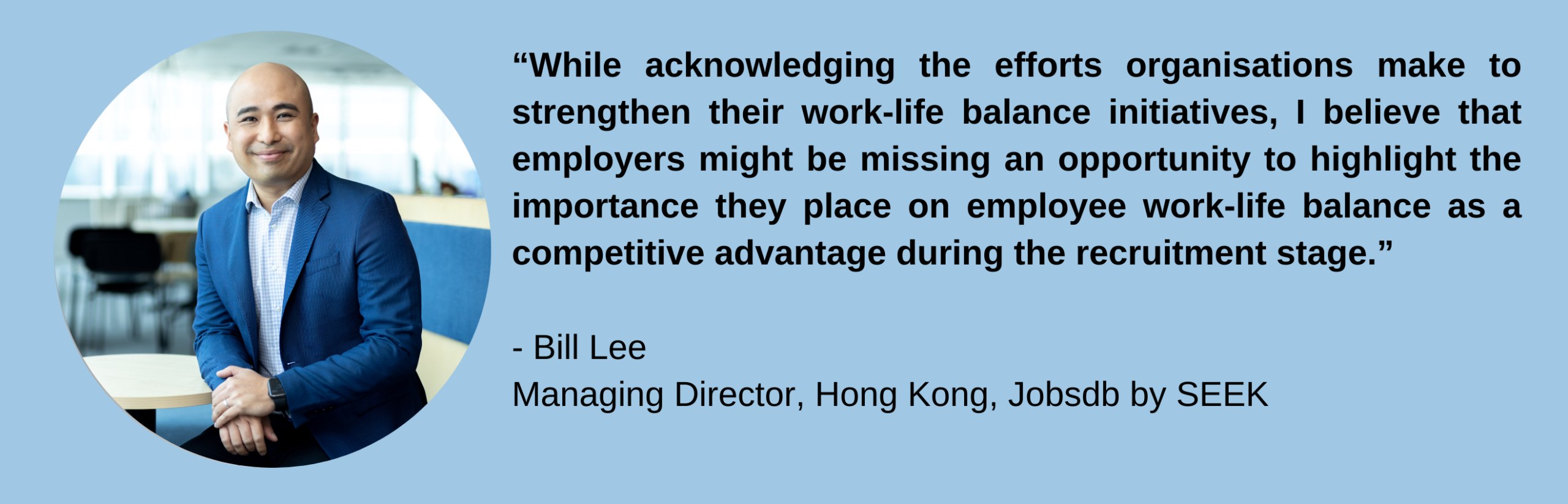
While acknowledging the efforts organisations make to strengthen their work-life balance initiatives, Bill believes at the recruitment stage employers could be missing out on an opportunity to highlight the focus they place on employee work-life balance as a competitive advantage. For example, if an organisation offers a competitive market level salary and all other employment details being equal, there is a strong possibility it will be the work-life balance element that acts as the deal maker or breaker.
Bill also notes how the need to create a better balance between what people do for a living and what else they want in their lives extends to lifelong learning. With three quarters of the “2023 Future Workforce Study” respondents reporting they have an appetite for lifelong learning, Lee says the challenge for employers is how to effectively structure a lifelong learning framework. Future of Work Study respondents reported they seek hard skills such as certification, data training and language skills as well as leadership, communication, and interpersonal soft skills training. “The goal is to ensure that lifelong learning covers both sides of the equation,” Bill says. Focus needs to be directed at incorporating on-the-job learning into everyday work. More specifically, Bill adds there should be a clear correlation between the lifelong learning direction the employee wants to go and the needs of the organisation. “To make lifelong learning effective there are times when management need to insist that employees participate in certain types of learning and training programmes,” says Bill.
The mutual benefits of meaningful internships
Roy Ying, the Co-Chairperson of Advocacy and Policy Research Committee at HKIHRM, recognises the mutual benefits of internships for both interns and host organisations. However, he highlights that internships often fall short of their intended goals due to discrepancies in how they are defined, how employers prioritise them, and how interns are mentored. Roy, who also serves as the Programme Director of BBA-Marketing in the Department of Marketing at the Hang Seng University of Hong Kong, underscores the divergence between organisations that view internships as a means to develop their talent pipeline and those that categorise them as corporate social responsibility contributions.
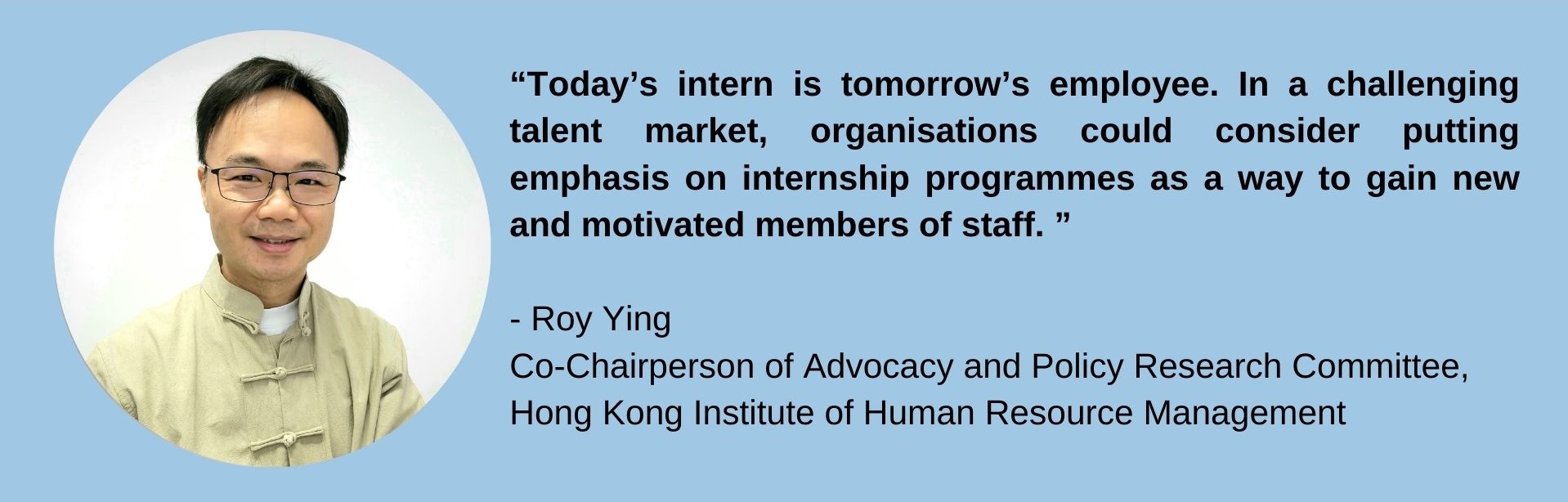
From the students’ perspective, Roy notes that while a significant percentage acknowledges the value of internships, they often lack motivation to pursue alternative internship opportunities unless they secure intern positions with reputable organisations known for offering meaningful experiences. The lack of motivation stems from the perception that internships are unrewarding and involve menial tasks unrelated to their career development. “Obviously, there is a need to bridge this gap,” emphasizes Roy. In a competitive talent market, organisations should prioritise internship programs as a strategy to attract new and enthusiastic staff members. However, to achieve this, organisations must ensure that their internship programs are well-structured and provide planned supervision. Roy emphasises the importance of investing time in grooming interns if organisations consider them as part of their future workforce.
To facilitate students’ practical exposure in their chosen fields, Roy advocates for enhanced collaboration between universities and employers to align business prerequisites with students’ needs. One major hindrance is the scarcity of paid internship positions, which leads to intense competition among students for the limited opportunities offered by multinational corporations (MNCs) and listed companies in Hong Kong as these organisations typically provide reasonable wages to interns. However, SMEs struggle to attract interns due to resource constraints and the lack of compensation. To address this issue, Roy recommends that the government consider allocating funds to subsidise organisations that lack the financial means, such as SMEs, NGOs and start-ups, to offer paid internships, thereby reducing the perception of internships as unpaid or cheap labor. This approach could transform the internship landscape by encouraging more employers to provide appealing internship programmes. Moreover, the subsidy requirement would motivate employers to invest time and resources in developing comprehensive internship proposals, ultimately enhancing the structure of the internship experience. Roy also suggests that the government take the lead by promoting its own civil-service internship programs as “best practice” examples for private enterprises, contributing to the development of Hong Kong’s future workforce. Roy added, “It’s worth the investment because today’s interns are tomorrow’s employees.”