Parents’ Influence on Adolescents’ Career Domains
Indirect influence of parents means the interventions from parents, their special efforts in encouraging children to engage in activities such as providing plenty of musicals at home, having science discussions, visits to galleries and art exhibitions, encouragement on finding a job and so on. These interventions can orientate children and adolescents, intentionally or unintentionally, arousing children’s interests and curiosity for further exploration in the fields.
These parents’ interventions and mediation efforts have an essential role to play in affecting children’s occupational aspirations, consideration of educational and professional possibilities. The home environment laid the foundation of a child’s personality. Research found that parents’ influence was the most prominent in affecting their children’s career choice (Kazi & Akhlaq, 2017; Nguyen et al., 2023).
Parents’ influence can be passed onto their children via direct influence such as values transmitted through parents’ genes and actual parenting so that their children make the choices that they do.
Most Olympic medal winners found their interests and started training in their early age. The recent Hong Kong DSE Examination results show examples of significant childhood accomplishments. One student received straight-in offer from the HKUST because of his extraordinary performance in programming financial trading games. Another student at his present age of 9 took the exams of two advanced math subjects and received top scores in both. These individual achievements started at early age, very likely under the influence of their parents.
Human Value Models and Career Domains
Some classical models such as the Social Cognitive Career Theory (SCCT) (Lent et al, 1994) and Schwartz’s value model (1992, 2012) shed lights on personal career development. The SCCT consists of three interrelated components of career development: i. development of basic academic and career interests; ii. choices of education and career; and iii. academic and career attainment. Garcia-Perez et al. (2019) found that the stronger the perceived family support, the greater the adolescents’ beliefs about their own ability to succeed in the related subject, the more of the students’ desire to persevere in their studies and professional performance.
A longitudinal 35-year research by US National Academy (Rozek et al., 2017) confirmed that parents could cultivate their children’s interests in the STEM subjects and communicate their importance with their children. Qualitative research of Craig et al. (2018) examined the influence of parents on students’ entering STEM career. Such influence started in the very early stage of parenting in students’ childhood through experience, stories and self-identity.
Schwartz’s theory (1992, 2012) defines some broad values based on the underlying human intentions and motives. These broad values include: Self-Direction, Stimulation, Hedonism, Achievement, Power value; Security value, Conformity value, Tradition values, Benevolence and Universalism (Schwartz & Cieciuch, 2016). Schwartz found that humans had different values conflicting as well as balancing to arrive at a behaviour and decision that was the most desirable to oneself.
Organisational adaptability
By genetic algorithms, Schneider, et al. (2024) analysed the correlations between work values and basic human values. The study with 853 German samples reflected strong correlations of 11 work values to most of the social and individual work motives, environmental sustainability awareness, neuroticism and basic human values. Thus, human values imply further links and effects on people’s organisational behaviours.
Implications and Suggestions
Career Decision-making and Work Behaviour
Regardless of whether young adults’ career decisions are the results of their parents’ values or interventions during schooling, parents have a significant role to play in adolescents’ career decision-making and future work behaviour.
Career Exploration and Inspirations
Education institutes and governments are more and more aware of the importance of work experiences, internship and career activities. There is increasing collaboration between education and industries in the provision of working experiences to the youths. Final career choice and long-lasting motivation for taking a step further can be driven by environmental support especially from families and parents.
It was found that people spent about 12 hours daily on social media in 2017 (Potter, 2019). Media and AI influences on individuals are stronger than ever. Social media penetrates culture. Under the strong influence of media and metaverse, many young people enjoy living in the virtual world. Parents and family influences are reducing. Parents need to build relationship and trust with children in their early years of age allowing assistance in expanding children’s positive human values so that young adults can have an easy transition into adulthood.
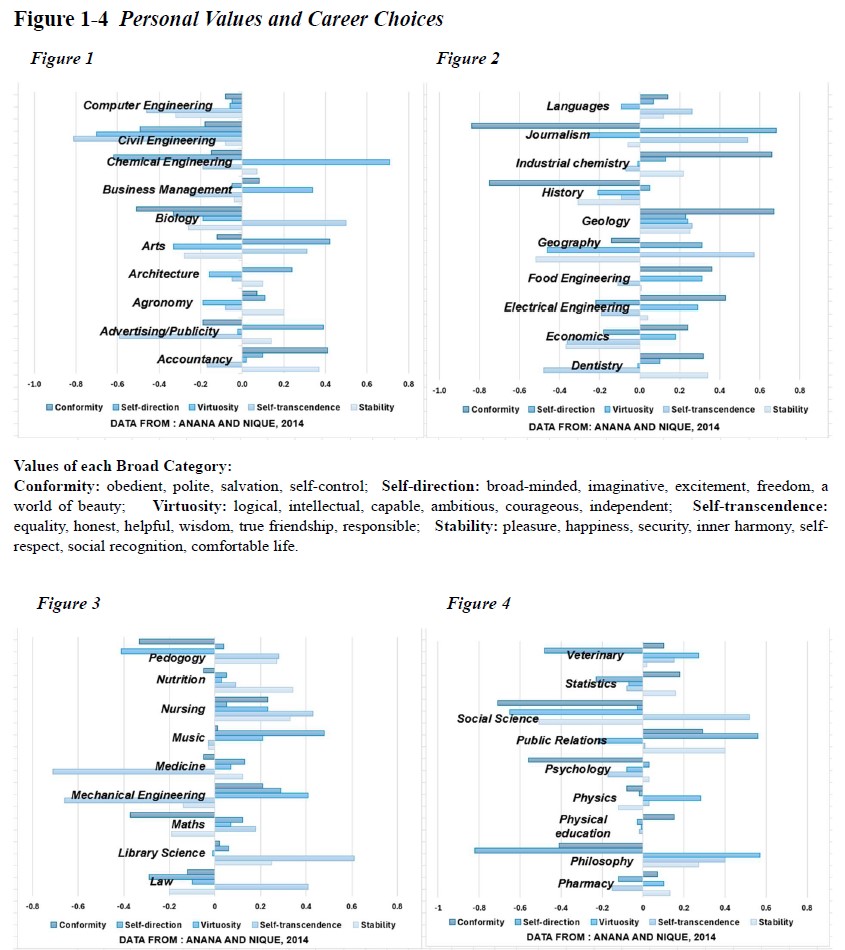
Parents can effectively guide their children by encouraging them to explore a variety of interests and activities in early stages of nurturing. Parents significantly influence their children’s career 3 perspectives through their own professional dedication and enthusiasm. Parents with stable income and professional training are more inclined to provide information on various careers, including occupational roles, market trends, and educational pathways, arousing children’s sense-making exploration about career and interests. These families are more resourceful and can provide career information and guidance. For mitigating the disparity in socioeconomic status of different families, governments can facilitate better career services in the community for families in need. Before parents guide their children, more career resources can narrow the occupational information gap and make support available for parents to expand children and adolescents’ fundamental human values. Research has suggested that certain careers reflect certain values than others. With clear personal values deeply rooted, adolescents can naturally map themselves into and consider relevant curriculum and job characteristics (Figure 1-4), saving adolescents from anxiety, unnecessary struggle in career choices and future job changes.
Development of Creativity and Independence
In the era of artificial intelligence, family education is adapting to new methodologies that emphasize the comprehensive development of children’s abilities. The focus is on cultivating creativity, independence and emotional intelligence – the key human traits that differentiate us from machines. With the ever-evolving technology and job market, fostering a lifelong learning habit is crucial for children to remain adaptable and future-proof. Equipping children with the ability to collaborate effectively with AI is essential, as it prepares them to generate innovative solutions alongside intelligent systems. AI presents opportunities for personalized education, allowing family education to be tailored to the specific learning needs of each unique child.
Nurturing independence is the key, allowing children to make decisions that foster selfconfidence and a sense of responsibility, crucial as they face differences in employment views between different generations. Supporting children’s educational choices is essential for aligning their interests, learning and future career. Collaborating on career planning helps set clear goals and develop strategies for achieving them, while also preparing youths for the dynamic nature of career building and organisational adaptability.
Ultimately, parenting with respect and support on children’s choices, even when their children diverge from parental expectations, is vital. This not only alleviates pressure on the young adults, but supports their pursuit of career aspirations. As indicated by survey data that 94.4% of recent graduates feel relieved when their job choices are supported by their parents. These strategies, when thoughtfully implemented, provide a comprehensive approach to guiding children towards a fulfilling career path. In Figure 5, Anana and Nique (2014) identified the association of the career choices with the value dimensions of conformity, self-direction, virtuosity, selftranscendence and stability.
Career Services for Parents
Career data bank for parents to delve into career information and resources can enable parents to first master the knowledge and be informative before guiding their children. Career talks and services for parents update them on the vocational needs, skills demand and the market trends. Personality assessments and career counselling for both youths and parents can be made easily available. Government may invest more on technology for youngsters’ career development.

Job Simulations and Events
More career services centres with AI-powered job simulations will enable children and young adults some taste of different job types before they make course and career choice. Instead of targeting at the adolescents, higher education can involve parents as consumers in future marketing strategies, course promotion and curriculum planning. If STEM subjects are our 5 future, more science museums and STEM experiential events in the community can cultivate curiosity and interests.
In summary, the formative influence of parents on a child’s career trajectory is profound and should begin at an early stage of child development. With clear and mature personal values, provision of the essential career information and resources, career planning guidance from parents can prepare adolescents to manage environmental and technological changes. However, we should not stereotype children and youths with job types too early, imposing forced career. When the whole world is entering higher level of automation in all industries and everyday life, special efforts in expanding adolescents’ personal values will enable the development of more right fits for future societal and economic needs.
References:
- Craig, C.J., Verma, R., Stokes, D., Evans, P. & Abrol, B. (2018). The influence of parents on undergraduate and graduate students’ entering the STEM disciplines and STEM careers. International Journal of Science Education. DOI: 10.1080/09500693.2018.1431853
- Desjardins, T. and Leadbeater, B. (2017). Changes in Parental Emotional Support and Psychological Control in Early Adulthood: Direct and Indirect Associations With Educational and Occupational Adjustment. https://Doi:10.1177/2167696816666974
- Dewar, G. (2019). Traditional Chinese parenting: What research says about children and why they succeed. Parenting Science at https://parentingscience.com/chinese-parenting/
- García-Pérez, O., Inda-Caro, M., Fernández-García, C. M., & Torío-López, S. (2019). The influence of perceived family supports and barriers on personal variables in a Spanish sample of secondary school sciencetechnology students. International Journal of Science Education, 42(1), 70–88. https://doi.org/10.1080/09500693.2019.1701216
- Heaven, P. C. L., & Newbury, K. (2004). Relationships between adolescent and parental characteristics and adolescents’ attitudes to school and self-rated academic performance. Australian Journal of Psychology, 56(3), 173–180. https://doi.org/10.1080/00049530412331283327
- Kazi, A.S. and Akhlaq, A. (2017). Factors Affecting Students’ Career Choice. Journal of Research and Reflections in Education December 2017, 2: 187-196.
- Lent, R., Brown, Steven, B., Hackett, G.(1994). Toward a Unifying Social Cognitive Theory of Career and Academic Interest, Choice, and Performance. Journal of Vocational Behavior, 45(1):79-122. DOI:10.1006/jvbe.1994.1027
- Potter, J. (2019) Media Literacy. California: Sage Publications.
- Ratelle, C.F., Larose, S., Guay, F. & Senecal, C. (2005). Perceptions of Parental Involvement and Support as Predictors of College Students’ Persistence in a Science Curriculum. Journal of Family Psychology, 19(2), Jun 2005, 286-293.
- Rozek et al, (2017). Utility-value intervention with parents increases students’ STEM preparation and career pursuit. Journal of Psychological and Cognitive Sciences, 114 (5) 909-914. https://doi.org/10.1073/pnas.1607386114
- Ryan, N. E., Solberg, V. S., & Brown, S. D. (1996). Family dysfunction, parental attachment, and career search self-efficacy among community college students. Journal of counseling psychology, 43(1), 84.
- Schneider, J., Striebing C., Hocfeld, K. and Lorenz, T. (2024) Establishing circularity: development and validation of the circular work value scales (CWVS). Frontiers in Psychology 15. https://doi: 10.3389/fpsyg.2024.1296282
- Schwartz, S. H. (2012). The Refined Theory of Basic Values. Roccas, S. and Sagiv, L. (Eds). Values and Behaviour: Taking a cross-cultural perspective. Springer
- Schwartz, S.H. (2021). A repository of Schwartz value scales with instructions and an interdiction. Online Readings in Psychology and Culture, 2: 9. Doi: 10.9707/2307-0919.1173
- Schwartz, S.H. and Cieciuch, J.(2016). Measuring the Refined Theory of Individual Values in 49 Cultural Groups: Psychometrics of the Revised Portrait Value Questionnaire. Assessment 29(5).
- Šimunović, M., Ercegovac, I. R. and Burušić, J. (2018). How important is it to my parents? Transmission of STEM academic values: the role of parents’ values and practices and children’s perceptions of parental influences. International Journal of Science Education, 40(9), 977-995. https://doi.org/10.1080/09500693.2018.1460696
- Trong Luan Nguyen, Huu Tri Nguyenb, Ngoc Han Nguyenb, Dai Loi Nguyenb, Thi Thu Dao Nguyenb, Duy Linh Leb (2023) Factors affecting students’ career choice in economics majors in theCOVID-19 post-pandemic period: A case study of a private university in Vietnam. Journal of Innovation & Knowledge, 8. https://doi.org/10.1016/j.jik.2023.100338
- Wang, Y.F., Li, Z.; Zhu, L.(2019). Emotional intelligence of 3- to 6-year-olds and parenting style: Peer communication ability as a mediator. Social Behavior and Personality: an international journal, Vol 47(12), pp. 1-12. https://doi.org/10.2224/sbp.8636