As we stand at the crossroads of technological innovation, talent scarcity, and evolving job landscapes, the insights presented in the HKIHRM Future Workforce Study 2024 (Study) prompt us to embrace adaptability, foresight, and strategic planning. The Study goes beyond mere numbers to delve into the complex forces shaping the future of work in our bustling city. It encourages us to not just observe trends but also to predict, innovate, and take the lead in the realm of workforce management.
The Study highlighted three key trends in Hong Kong’s employment landscape. Firstly, the market is currently witnessing less difficulties in filling job vacancies with varying implications for businesses of different sizes and industries. Secondly, it is revealed that there is a decrease in demand for traditional positions which reflects the impact of technological advancements and automation. Thirdly, the Study also uncovered the reasons of why some local businesses are reluctant to adopt overseas talent admission schemes and the ways that they can be incentivised to participate.
Finding the right people for the jobs – The easing vacancy challenge
While it is still challenging for employers to fill their vacancies, we are seeing some signs of alleviation for such challenge.
The Study indicates that from April to June 2024, only 16% of employers who participated in the Study indicate it is “extremely difficult” for them to fill vacancies. Not only is this a significant drop from 28% in March 2024, 16% is also the lowest figure we obtained since we started tracking this trend in 2022.
Moreover, 23% and 5% of the employers expressed that it is “not that difficult” and “not at all difficult” to fill their vacancies. Both figures are the highest since we started conducting this Study in 2022.
However, Lawrence Hung, president of HKIHRM clarified that this easing trend is not evenly felt across businesses of various sizes and sectors.
He pointed out that smaller businesses (with less than 100 employees) generally have an easier time filling their vacancies due to the greater flexibility of their recruitment processes. 27% and 9% of these businesses stated that it is “not that difficult” or “not at all difficult” to fill their vacancies.
For medium-sized businesses, it is evident that they face greater difficulties in filling their vacancies. 20% of them expressed that recruitment is “extremely difficult”, while 63% expressed that the situation is “quite difficult”. Lawrence explained that medium-sized businesses generally have longer recruitment processes and are facing stiffer competition for similar types of talents from more competitors.
For comparison between sectors, ‘hospitality & catering”, “property management & real estate development” and “architecture, engineering & construction” are facing the biggest challenges in filling vacancies. This is especially true for employers in the hospital & catering industry, with 45% and 55% of them expressing that the recruitment situation is “extremely difficult” and “quite difficult”.
Lawrence explained that with the end of COVID, the “hospitality & catering” industry has resumed normal operation. However, the surge in demand for manpower is not supported by a corresponding increase in labour supply, as employees who previously worked in this sector have already switched fields during the pandemic.
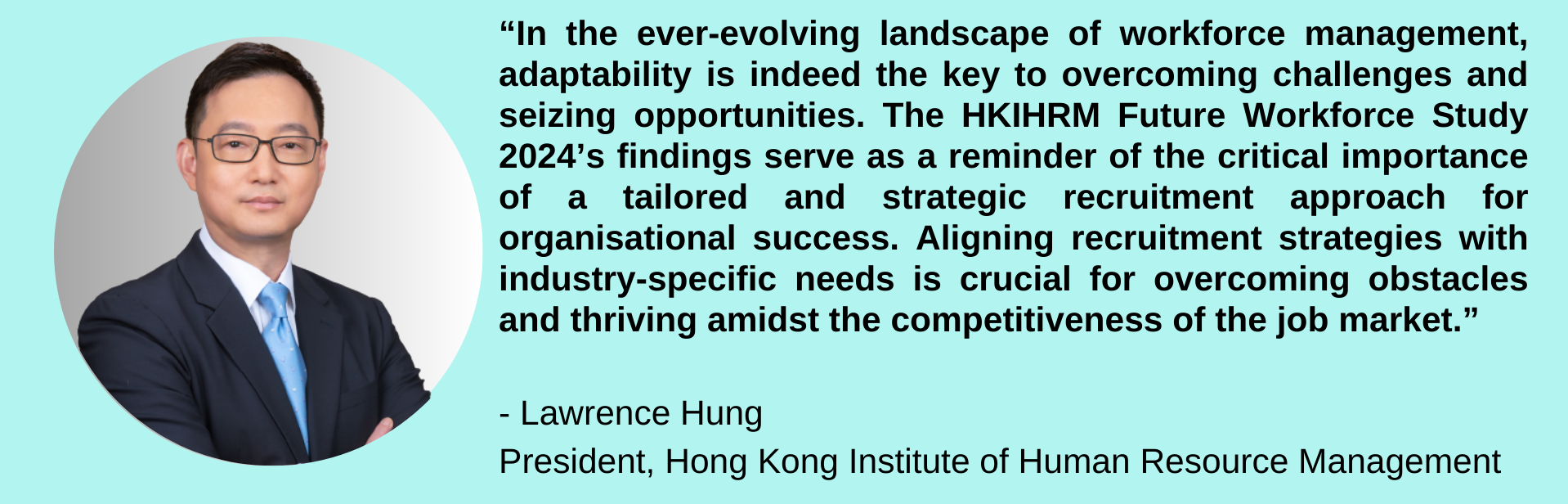
Lawrence emphasises, “In the ever-evolving landscape of workforce management, adaptability is indeed the key to overcoming challenges and seizing opportunities. The study’s findings serve as a reminder of the critical importance of a tailored and strategic recruitment approach for organisational success. Aligning recruitment strategies with industry-specific needs is crucial for overcoming obstacles and thriving amidst the competitiveness of the job market.”
Bill Lee, Managing Director, Hong Kong of Jobsdb by SEEK, further explained that the irregular and long working hours of the “hospitality & catering” industry, coupled with insufficient remuneration, also worsened the hiring difficulties.
However, he noted that the government has recently introduced the “Re-employment Allowance Pilot Scheme (REA Scheme)”, which supports middle-aged and unemployed individuals to reenter the workforce through the offering of job vacancies in various industries and government subsidies. This may help provide a fresh workforce to help fill the current labour gap.
Emerging jobs and Disappearing jobs – the decrease in demand for traditional positions
While automation has been a constant factor affecting the employment landscape, the rise of artificial intelligence’s use in everyday work has brought the issue of automation to the forefront again. The Study projected that there will be 0.2% decrease in demand for manpower in large businesses as larger corporates have more resources to adopt automation and efficiency enhancement measures, while smaller businesses face a harder time to implement such arrangement.
As for the demand for manpower in different sectors, with a few mega infrastructure projects kickstarting, including the “The Northern Metropolis” and “Kau Yi Chau Artificial Island”, the Study predicted the “architecture, engineering & construction” sector to experience an 8% projected growth in manpower projection. The other two sectors also with projected growth are “trading” and “property management & real estate development”, forecasted to experience a 6.4% and 4.9% growth respectively.
With the advent of further automation and artificial intelligence and their potentials in streamlining work processes, some sectors are predicted to undergo contraction. These include a 4.5% contraction in “logistics & transportation”, 3.1% in “retail & wholesale and 0.6% in “telecom, multimedia & technology”.
The demand for manpower across different job roles also vary under the impacts of automation and artificial intelligence. 33% of the employers who participated in the Study believed that there will be increasing demand for “IT manager, programmer, software engineer and cloud engineer”, while 16% of them believed that demand for client centric roles, such as “sales manager, shop manager, sales supervisor / executive”, will also increase.
Lawrence pointed out that as automation progresses, the market requires a substantial increase of talent to maintain and operate such systems, while client centric roles are also needed to liaise between technical personnel and the clients.
Lawrence also noted another interesting result from the Study that while 71% of the employers believed there will decreasing demand for “admin / clerical” roles, 10% of them predicted there will actually be an increase in demand for these roles.
Bill explained that while automation reduces demand for roles that are responsible for repetitive clerical tasks, it would also encourage people in danger of being replaced to upskill or reskill themselves to utilise AI, so that they can become “gatekeepers” within organisations to help review the work done by AI.
While smaller businesses may face difficulties in adopting new technologies, Bill observed that as this new wave of digital transformation catches on, more and more opportunities will become available for these smaller businesses to leverage technology in their business operations.
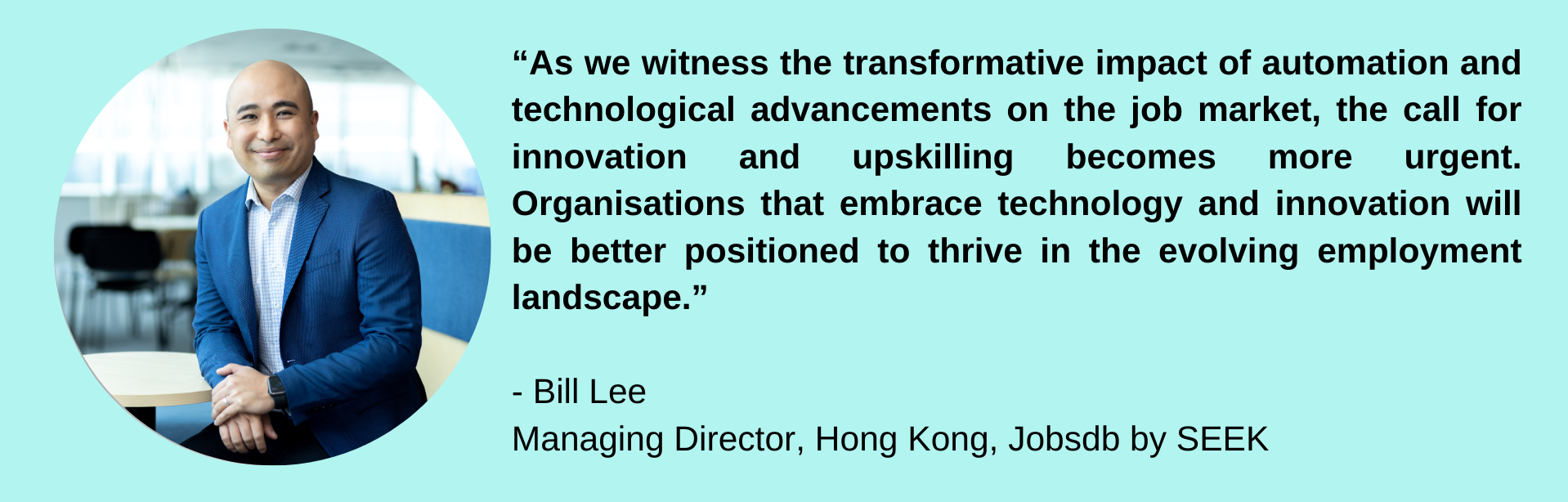
Bill added, “As we witness the transformative impact of automation and technological advancements on the job market, the call for innovation and upskilling becomes more urgent. Organisations that embrace technology and innovation will be better positioned to thrive in the evolving employment landscape.”
Help from outside – the current situation of recruiting overseas talent via talent admission schemes
While the employment landscape in Hong Kong remains challenging for employers, the Study discovered that only 28% of the employers applied for talent admission schemes in 2023, while a significant 61% had never done so.
When the 61% of the employers were asked why they didn’t participate in any talent admission schemes, the top three reasons are: it is more straightforward for them to recruit locally (43%), costs considerations (26%), and non-locals are not suitable for their jobs (22%).
Among those employers who expressed that it is more straightforward for them to recruit locally, 96% of them are in “trading” sector, while 88% of them are in the “retail & wholesale” sector. Bill explained that these sectors often require their employees to be more well-versed in the local market dynamics, thus their preference to prefer recruiting locally.
Comparing all the talent admission schemes, the “Immigration Arrangements for Non-local Graduates” (“IANG”) is the most popular one among employers, preferred by 58% of the interviewed employers. Bill pointed out that since IANG is designed for non-local graduates or graduates from the Greater Bay Area who choose to remain in Hong Kong for work after completing their studies, these candidates usually have a better understanding of the local culture and work habits.
In response to the reluctance by employers to recruit from overseas, the Study also asked the employers what kind of support the Government can provide in relation to these schemes, and how the schemes can be further improved to attract participation by employers. The Study mentioned that nearly 70% of employers expressed that the Government can offer more guidance on the visa extension processes, while 55% of them expressed that the Government can provide more details on immigration and those talent admission schemes.
However, the request for support on other issues, such as: assistance on accommodation (48%) and Cantonese language learning (47%) etc., are also in high demand.
As for improvements to the schemes, 64% of employers expressed that the Government should simplify the admission procedures, while nearly 50% hope for shorter approval time.
Both Lawrence and Bill believed that the Government could take the initiative to organize more industry-specific seminars and fairs to enhance the overall transparency of these schemes and make arrangement for employers to keep track of the application progress.